Achieving Your Climbing Goals: A Plan Better Than 'Climb More'
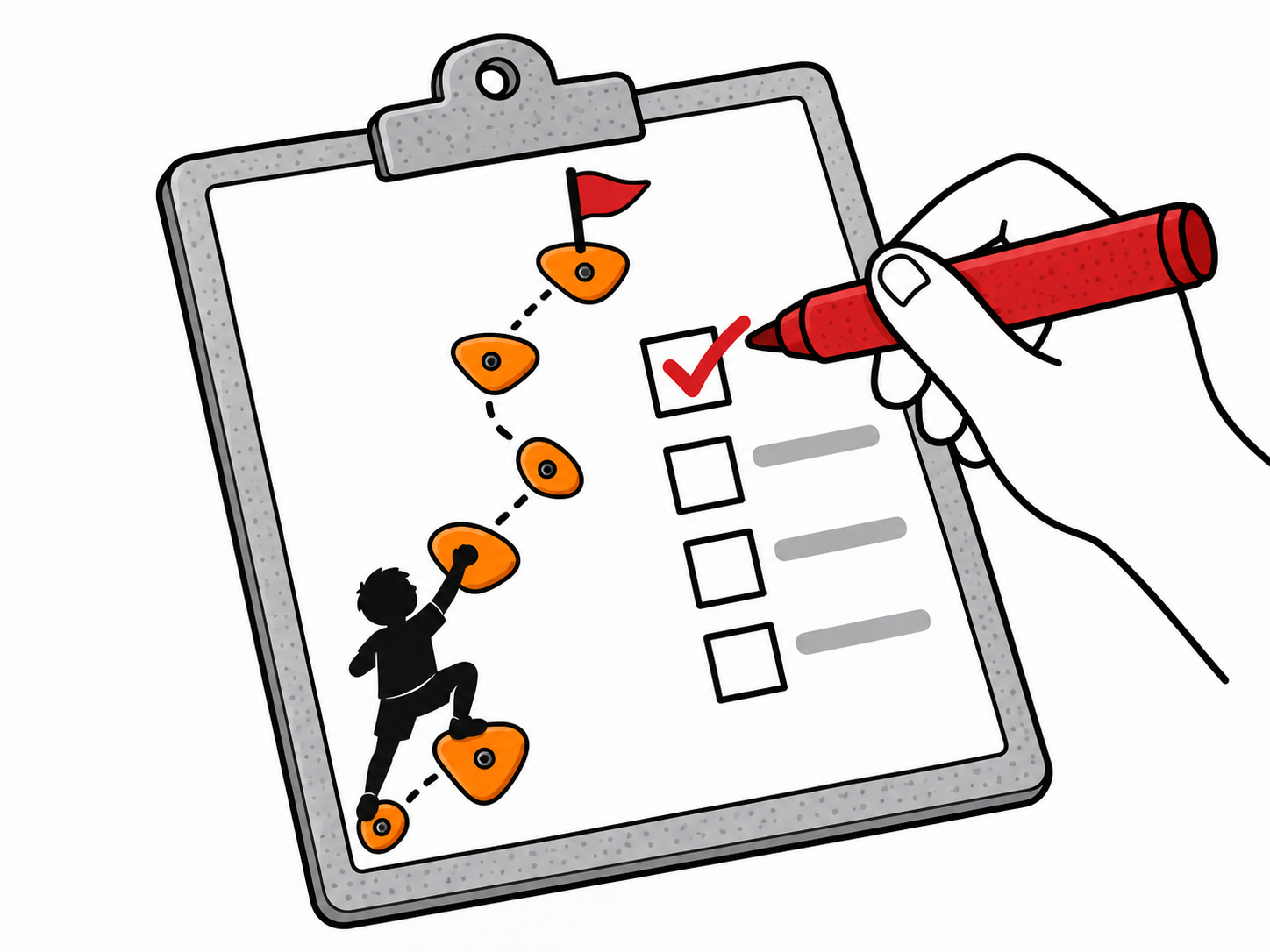
Most climbing goals start life as a vague wish: "I want to climb harder." It's a lovely sentiment, and it has the same effect on your progress as wishing for a sandwich has on your lunch. Real improvement needs a plan. Good planning is essential if the proposed objectives are to be met, and this guide walks through how to do it without turning your hobby into a spreadsheet nightmare. Only a mild spreadsheet.
Step 1: define the goal properly
"Climb harder" is not a goal. "Send a 7b by the end of October" is. A good goal is specific, measurable, time-bound and relevant to what you actually want to climb. Write it down. Then write down why you want it, because motivation is easier to keep when you can find its reasons on a bad day.
Also set expectations. Be honest about how much time you can train, and how much life will interfere. A plan built for a professional athlete is useless for someone with a job and a dog.
Step 2: find your weaknesses
You can't fix what you haven't identified. Make a list of what limits you: finger strength, power endurance, technique, body tension, mental focus, or just showing up. Use tests to get real numbers, and see our five performance tests for a starting point.
Do an honest psychological evaluation too. Do you avoid overhangs? Panic on runouts? Give up when a project gets hard? Those patterns cost more grades than weak fingers ever will. Analyze your sensations, and note when you feel fear, boredom or frustration.
Step 3: train for your target
Train specifically for your project or discipline. A boulderer and a route climber need different things, and copying the plan of a stronger friend is just a way to arrive at their injuries.
- Design your own boulders and circuits. Setting problems teaches you movement and forces you to think about difficulty.
- Propose difficult problems within your means. Hard enough to challenge you, not so hard that you leave frustrated.
- Include common physical problems. Overhangs, slabs, compression, tension. Then mix in problems without hands or feet, which sounds sadistic and works extremely well for body awareness.
- Repeat movements until difficult becomes easy. Repetition builds automatic skill.
- Look for the error you keep repeating, and fix that error first.
- Follow the three principles of training: power, control and technique. Neglect one and it will bill you later.
Step 4: use the right tools
- Fingerboard: for grip strength, used carefully and progressively.
- Twisting and rotation work, for core control.
- Balance and coordination drills, such as a slackline or a fitball, and movements like rings, jumps and push-ups.
- Eccentric stretching, to recover while still training.
- Circuits and other methods, to build endurance in a structured way.
- A stopwatch. It ruins your excuses. Time your rests, hangs and attempts.
Step 5: test under pressure
Climbing outdoors involves stress that a friendly gym rarely provides. Do stress tests by playing with time and pressure: set a limited number of attempts, climb in front of people, or give yourself a countdown. Train concentration, and practise uncontrolled situations, such as unfamiliar holds or being tired. If you only train in comfort, comfort is all you'll be good at.
Step 6: record and review
Film your sessions. Watching yourself is uncomfortable and extremely instructive. You'll see the straight arms, the hips glued to the wall, the moment you stopped breathing. Combine that with a training log, and review it every few weeks to see what's changing.
Step 7: eat like an adult
Invest in good nutrition. Every individual responds differently to food, so experiment with timing and composition, and notice how you feel in training. Enough protein, enough carbohydrates and enough total calories will do more for you than any supplement with a lightning bolt on the label.
Step 8: protect your motivation
Within the training cycle, plan for it. Prevent frustration by setting intermediate goals, celebrating small improvements and taking easy weeks. Plan climbing trips to stay motivated. A trip on the calendar is the best training partner you'll ever have, because it never cancels.
Goals are just plans with deadlines. Write yours, test your weaknesses, train them, and repeat until the difficult becomes easy.
A worked example
Say your goal is to send a steep 7a in twelve weeks. Weeks one to four: base phase with volume, technique drills and a baseline test. Weeks five to eight: strength and power, with a fingerboard session and a limit bouldering session each week. Weeks nine to eleven: project-specific circuits at steep angles, with two attempts per session on the actual route. Week twelve: rest, then send. Test at weeks four and eight, and adjust the plan if the numbers disagree with your optimism.
When the plan meets real life
You'll miss sessions. Work will explode, someone will get sick, and one weekend will vanish into a wedding. That's fine. Don't try to make up lost sessions by doubling the next one, which is how injuries get invited. Drop the least important session, keep the key one, and carry on. Consistency beats heroics, every time.