Supercompensation for Climbers: Why Training Harder Isn't Training Better
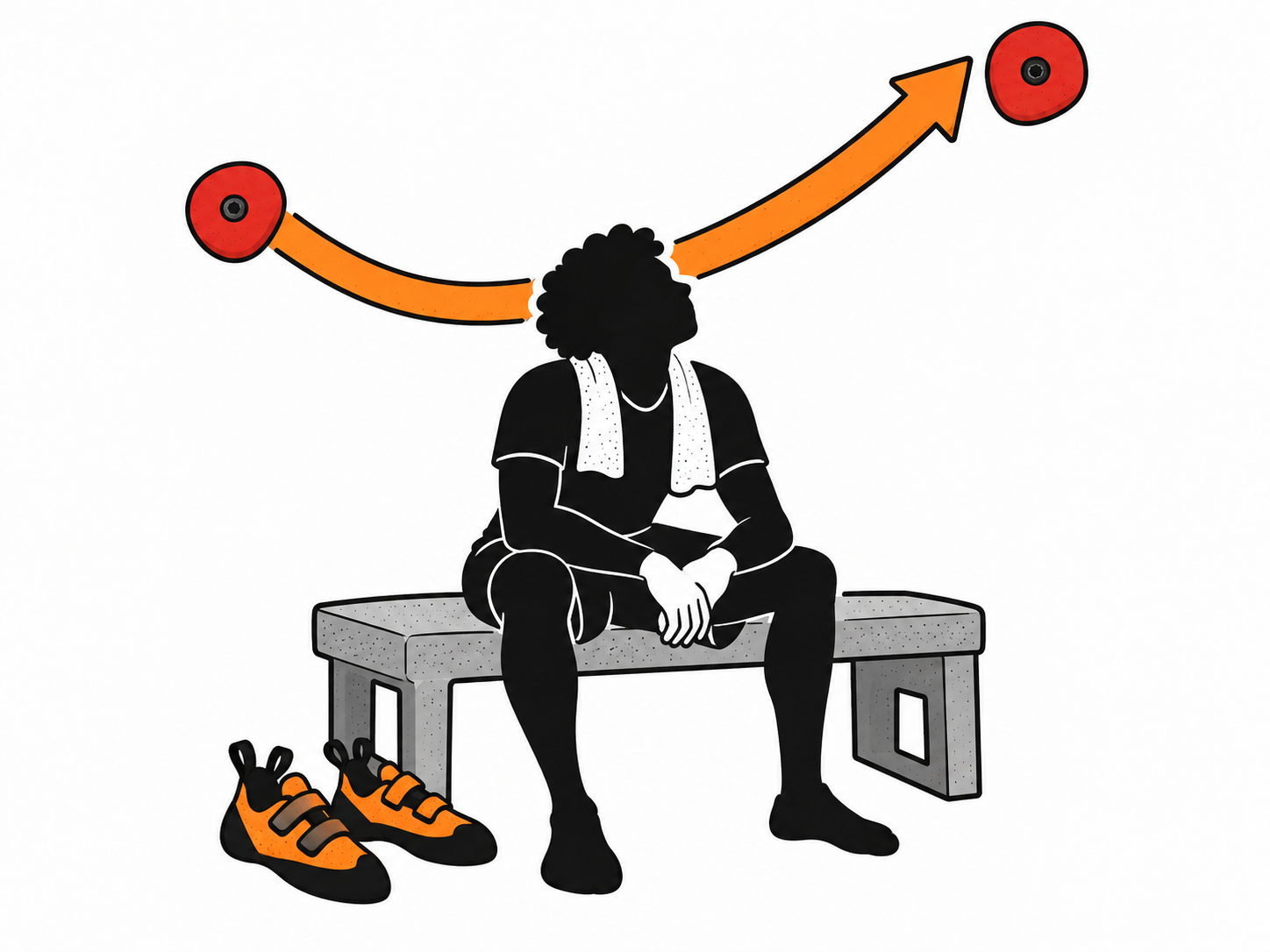
Every climber has a friend who trains six days a week, sleeps five hours and wonders why they've plateaued since 2019. Their diagnosis is always the same: "I need to train harder." Their body's diagnosis is: "Please, stop." The concept that explains this conflict is called supercompensation, and it may be the most useful idea in all of training that nobody wants to hear.
What supercompensation actually is
When you train, you don't get stronger during the session. You get tired, slightly damaged and depleted of energy. The improvement happens afterward. Given adequate rest, food and sleep, your body recovers and adapts to slightly exceed its previous level, so it's better prepared for the same stress next time. That overshoot is supercompensation.
Think of it in four phases:
- Stress: the training session causes micro-damage and energy loss.
- Fatigue: performance drops, and you feel it.
- Recovery: the body repairs and refuels, returning to baseline.
- Supercompensation: for a limited window, you're slightly above baseline. Train inside that window and you build on it. Wait too long and the benefit fades. Train too soon and you dig a deeper hole.
Recovery timelines vary. Muscular energy stores can rebound within a day or two, while tendons, ligaments and the nervous system take longer. That's why your forearms may feel fine while your fingers are quietly filing a complaint. Around 24 hours after a session, adaptation is well underway, but heavy finger or power work often needs 48 hours or more.
Treat your session like a long route
Imagine climbing a five pitch wall at your maximum intensity. That's what a good endurance session should mimic. Instead of one long grind, break it into sections: climb five routes or circuits at your max, each a sequence you set on your panel. Rest between them so each attempt is high quality, rather than a decaying blur of "well, I'm still on the wall".
A practical structure:
- Warm up for 15 to 20 minutes, ending with a couple of hard moves.
- Climb five sequences of about 25 to 40 moves each at a hard intensity.
- Rest 3 to 5 minutes between sequences. Long enough to perform, short enough to feel the fatigue.
- Finish with easy climbing or mobility, then eat something that isn't a protein bar.
Progressive overload: the non-negotiable
If you do the same session, at the same load, for months, your body has no reason to change. Adaptation needs a nudge. Progressive overload means slightly increasing the demand over time. You can do that by adding a move to your sequences, reducing rest, adding a route, using smaller holds or making the angle steeper. Change one variable at a time, and increase it modestly. A purely linear plan gets boring, but random chaos is worse. Sequences change over time, and the load creeps upward.
Set sequences that mimic your goals
Design your circuits to mirror the projects you're trying outdoors, or the competition routes you'll face. Match the hold types, angle and movement style as closely as you can. The objective is to last longer on the wall and complete at least 70% of the moves you set. If you set a 30 move sequence, aim to climb at least 25 without falling. If you finish everything easily, it's too easy. If you can't get past move ten, it's too hard. That 70% zone is where useful stress lives.
Focus is part of the workout
The body learns resistance through repeated stress, but it learns skills through attention. Stay curious about your movement. Where are your hips? Are you overgripping? Are your feet quiet? Try to perfect the way you break down the technical movements unique to climbing, and treat every repetition as a chance to climb a bit more efficiently. Efficient climbers use less energy, and less energy means a longer time on the wall.
Signs you're missing the window
- Performance getting worse over two or more weeks, rather than better.
- Persistent finger or elbow soreness that doesn't fade with a rest day.
- Poor sleep, low motivation and irritability.
- A resting heart rate that trends higher than normal.
If several of these show up, take an easy week. Reduce volume by around half, keep some light movement, and sleep like it's your job. Coming back fresh often produces the best session in a month, which is supercompensation doing precisely what it says.
Train hard, rest harder, and let the adaptation do the heavy lifting. It works for free, and it doesn't need a subscription.
Nutrition and sleep: the actual recovery tools
Supercompensation isn't magic; it needs raw materials. Aim for enough protein throughout the day, carbohydrates around training to refill glycogen, and total calories that match your effort. Sleep is where most repair happens, so seven to nine hours is a training tool, not a luxury. A climber who sleeps five hours and blames their program is misdiagnosing the problem, and probably drinking too much coffee.
A simple weekly rhythm
For most recreational climbers, three to four quality sessions a week is enough: two hard sessions (power or strength), one endurance or circuit session, and one technique or easy volume day. Keep the hardest sessions separated by at least 48 hours, and keep at least one full rest day. If in doubt, do less and do it better.